Why BMI Matters to You
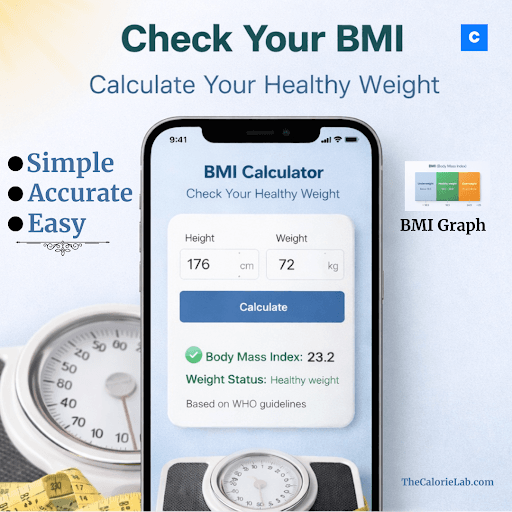
BMI helps you to know whether your current weight puts you at serious health issues or not. You can check your BMI SCORE at no cost with the BMI Calculator that matches WORLD HEALTH ORGANIZATION (WHO) standards
What Does BMI Measure?
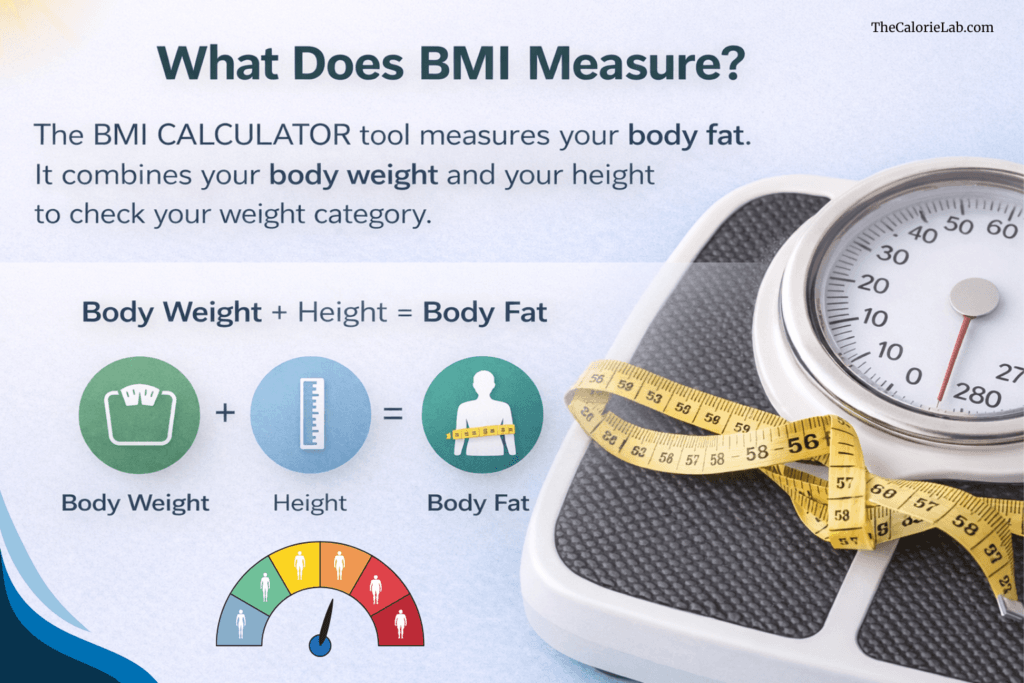
The BMI CALCULATOR tool measures your body fat. It combines your body weight and your height to check your weight category. Here is a step-by-step guide on how to MEASURE YOUR BMI correctly. Let’s discuss what different weight categories tell us about your health. Let’s check what the meaning of different weight categories is.
How BMI Tools Help You
BMI does not work directly to diagnose the disease. In fact, it tells your weight category, and according to the weight category, doctors can know which disease you can have, like if you have too much fat, so maybe you can face lung or heart issues. Different weight categories have different health issues, which are described in the next paragraph
Screening for Health Risks Using BMI
BMI is an easy-to-use tool; you can simply get your weight category by putting in basic information about your weight and height. Now, this table will show you how you can get a hint about health issues using your weight category.
BMI Weight Categories and Health Risks
Body Mass Index (BMI) is a screening tool used to categorize body weight. It does not directly measure body fat or diagnose medical conditions.
| BMI Range | Weight Category | Health Risk |
|---|---|---|
| Less than 18.5 | Underweight | Higher risk of malnutrition, bone loss, and weakened immune function |
| 18.5 – 24.9 | Normal / Healthy Weight | Generally low risk of weight-related health problems |
| 25.0 – 29.9 | Overweight | Increased risk of cardiovascular disease, type 2 diabetes, and metabolic disorders |
| 30.0 – 34.9 | Obesity Class I | High risk of developing chronic health conditions |
| 35.0 – 39.9 | Obesity Class II | Very high risk of serious health complications |
| 40.0 or higher | Obesity Class III (Morbid Obesity) | Extremely high risk; professional medical guidance is strongly recommended |
Color indicators represent general risk levels based on standard BMI classifications. For accurate diagnosis and treatment, consult a qualified healthcare professional.
BMI Full Form and Definition
BMI stands for BODY MASS INDEX. The BMI tool is a medically proven tool to check your weight and get your health hint. It uses a simple formula to calculate your weight category.
Formula = weight (kg) / height (m²).
Once you’ve calculated your BMI, it’s important to understand what the number means for your overall health. Check out our latest article, BMI Interpretation: What Your BMI Number Really Means for Health and Lifestyle.
You know why doctors still trust in this old method? Let’s dive into it.

Why Doctors Use BMI
Doctors and health experts use the BMI tool on a large scale. It’s not a modern tool; this strategy has been followed for centuries. The only difference is that now it can be measured by tools and in the past by manual calculations. Proven work to get the exact weight category, which helps doctors in diagnosing the health condition. Guess what? The great news is that you can check it manually using technology by knowing how to calculate. You will be stunned after knowing its history. Let’s discuss.
You can also learn here how to calculate BMI for Children, Adults, and Ethnic Groups differently.
History of BMI—Who Created It?
The initial formula of BMI was created by Belgian mathematician and statistician Lambert Adolphe Jacques Quetelet in the 1830s; he was searching for information regarding humans and population at that time. At the start, this tool was not available publicly, but now you can use it easily like our BMI tool. The present table of weight categories (you read above) was presented by a Japanese student in 2000.
Now that you understand what BMI is, you might want to know what your BMI number really means for your health. Read our latest article, BMI Interpretation: What Your BMI Number Really Means for Health and Lifestyle.
Conclusion
The BMI calculator is being used worldwide by industry experts, and it is considered one of the best methods to check your weight category. There are many false assumptions, like there are different types of BMI tools for boys, girls, teenagers, or pregnant women. But according to the WORLD HEALTH ORGANIZATION (WHO), BMI only considers your height and weight; all other factors are negligible. Different BMI tools add these different categories to make their tool look cool and unique, but it’s useless.

FAQs about BMI TOOL
1. What information is needed to calculate BMI?
Ans. You only need to put your age and height to check your BMI
2. Which BMI TOOL is best?
Ans. The BMI tool of “THE CALORIE LAB” is best
3. How does the BMI calculator work?
Ans. It’s simply used this formula to calculate results: “BMI = weight (kg) / [height (m)]²”.
4. What is my BMI if 170 cm and 70 kg?
Ans. Your BMI is 24.22
5. Which BMI is best for my AGE?
Ans. Being in the normal range of BMI is best at your age.
6. Does age matter in BMI?
Ans. No, your age does not matter; it only checks height and weight
7. Does my gender/sex matter in BMI?
Ans. NO, YOUR GENDER does not matter
8. What is the main purpose of BMI?
Ans. The main purpose of BMI is to check your weight category
9. What are the benefits of BMI?
Ans. It can help you to check your body fat level, which is the cause of several health issues
10. Can BMI results be misleading?
Ans. Well, there are very few chances, but yes, it can be
11. How can I lower my BMI naturally?
Ans. Simple by focusing on your food and daily activity
12. Why do I have a high BMI, but I am not fat?
Ans. It is because of your muscle mass not need to worry
13. Who created BMI?
Ans. Adolphe Quetelet, a Belgian mathematician, created it
14. What are disadvantage of BMI?
Ans. BMI does not tell you the exact health issue, but yes, it can give you a hint
15. Can drinking water help me to lower my BMI?
Ans. Water is not magic, but it can boost your energy so you can exercise for longer