How to Calculate and Read Your BMI
BMI may indicate serious health issues by giving you early warnings. If you’re new to BMI and want a clear understanding of what it is, check out our detailed guide, What is BMI? This content will help you to understand why your BMI is important and how you can check it correctly without any mistakes. Let’s dive in.
Is Your BMI Healthy?
Are you really healthy? This blog can help you to check your BMI correctly. After getting your BMI score, now you need to match it with the BMI CHART so you will come to know about your current weight category and possible health risks. You can also calculate your body fat. HERE IS THE BMI CHART
BMI Classification
| BMI Range (kg/m²) | Category | Description |
|---|---|---|
| Below 18.5 | Underweight | You weigh less than healthy for your height. |
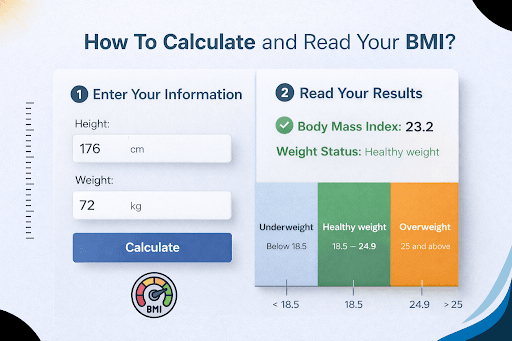
| 18.5 – 24.9 | Healthy Weight | Your weight is within a healthy range. |
| 25 – 29.9 | Overweight | Slightly above healthy weight. Risk of health issues increases. |
| 30 – 34.9 | Obese Class I | Moderate obesity. Higher risk for health problems. |
| 35 – 39.9 | Obese Class II | Severe obesity. Significant health risk. |
| 40 and above | Obese Class III | Very severe obesity. High health risk. |
Understanding Overweight, Underweight, and Obese Classifications
Matching your BMI score with the BMI chart is not enough. The BMI chart indicates the health problems you may face according to your weight category.
BMI Underweight
Being underweight means you are getting low nutrition according to your body’s needs. This can cause health issues like fatigue and weaken the immune system, which helps defend the body against illness. Focus on managing your diet and increasing nutrients.
Normal /Healthy Weight
BMI healthy weight is considered the perfect weight category. A normal BMI range means you are consuming good nutrients and is generally associated with lower health risks. You are good at keeping going on the same track. Well done.
Overweight
Being overweight is associated with higher health risks, but the good news is you can work on yourself to easily come back to a normal BMI range.
Obese
Well, this is the range where you should work on yourself; your body fat is more than required, and medical advice may be helpful in this category. This is the range where you have the most chances of falling into serious health issues.
Using a BMI Calculator
Let’s do a quick test. Check your BMI score right now to ensure you are not on the verge of any serious health issues. You can check this BMI CALCULATOR, which works on WORLD HEALTH ORGANIZATION (WHO) standards and helps you to measure accurate results.
Examples: BMI Calculations for Common Weights & Heights
Here are BMI scores for some common weights and Height Check this chart; you may find your BMI directly here; else, you can visit our official BMI tool.
Disclaimer: This table is generally an estimate.
| Height | Weight | BMI | Category |
|---|---|---|---|
| 150 cm | 45 kg | 20.0 | Healthy |
| 150 cm | 55 kg | 24.4 | Healthy |
| 150 cm | 65 kg | 28.9 | Overweight |
| 155 cm | 50 kg | 20.8 | Healthy |
| 155 cm | 60 kg | 25.0 | Overweight |
| 160 cm | 50 kg | 19.5 | Healthy |
| 160 cm | 60 kg | 23.4 | Healthy |
| 160 cm | 70 kg | 27.3 | Overweight |
| 170 cm | 85 kg | 29.4 | Overweight |
| 180 cm | 110 kg | 33.9 | Obese Class I |
Limitations in BMI
BMI also has some limitations. BMI cannot tell you the exact health issue. BMI cannot tell you the exact health issue, but it gives an estimate. For more details on why BMI can sometimes be misleading, check out Is BMI Accurate? What Most People Get Wrong About Body Mass Index: Moreover, you need a separate BMI tool to measure BMI for men and BMI for women. While men and women have different body compositions, our calculator provides accurate results for both in a single tool.
Moreover, if you are really short or if you are much taller, then your BMI results may vary. But of course, it’s a simple screening health tool, not a medical room where you can examine yourself.
BMI for Men
The commonly used tool is BMI for Men. The chart we commonly see is usually for men; there is a different BMI tool for women, but our tool is sufficient to calculate the results for both genders in a single calculator. If you are looking for the best BMI calculator, this is the tool that works on WORLD HEALTH ORGANIZATION STANDARDS.
BMI for Women
Most people did not agree that there is a different BMI tool for women because they think that BMI just calculates height and weight. Yes, they are right, but one thing they miss is that it cannot distinguish between fat and muscle. There is a difference between the composition of bodies of both genders, so there is a separate calculator.
You can also learn here how to calculate BMI for Children, Adults, and Ethnic Groups differently.
Is BMI Accurate?
BMI is accurate for the majority of adults, but if you are an athlete or you are much smaller or taller than others, you may see that your results may be slightly different, which is normal. Learn more about the common misconceptions and limitations of BMI in our article Is BMI Accurate?
To further explore why BMI isn’t always an accurate health indicator, read our detailed breakdown in BMI Interpretation: What Your BMI Number Really Means for Health and Lifestyle.
BMI Chart by Age and Gender
BMI is not accurate; it can have different results according to your gender and age. Because everyone has different body types across age groups, the provided BMI score chart is more accurate without any problem
Unlike other charts, it also explains BMI scores for different genders.
Disclaimer: This table is generally an estimate. Ranges are approximate and provided for general guidance only
| Age Group | Male Healthy BMI | Female Healthy BMI |
|---|---|---|
| 18–24 | 19–24 | 18–23 |
| 25–34 | 20–25 | 19–24 |
| 35–44 | 21–26 | 20–25 |
| 45–54 | 22–27 | 21–26 |
| 55–64 | 23–28 | 22–27 |
| 65+ | 24–29 | 23–28 |
BMI Formula (Metric & Imperial Units)
Well, the BMI formula, according to which our tool works, is as follows:
FORMULA= weight (kg) / [height (m)]²
To learn more about the origin of BMI and how it’s calculated historically, see our article What is BMI?
Conclusion
BMI is an effective way for basic screening for health. But BMI can vary with different age groups and genders. The chart for different gender and age-type groups is given above. You can choose our calculator that performs all tasks by itself, and you don’t need to match the chart. Moreover, BMI may be less accurate for athletes and individuals who are very tall or short. This is because BMI only considers your height and weight.
Disclaimer: BMI is a general screening tool that does not diagnose medical conditions.
FAQS
1. How do I read my BMI?
Ans. You can check our BMI chart to read about your BMI weight category
2. Is 37.5 BMI high?
Ans. Yes, it means your fat level is high, which is a significant indicator of increased health risks.
3. How to read a BMI CHART?
Ans. Check our blog for a step-by-step guide on how to read BMI scores correctly.
4. What is the BMI of 70 kg, 5 feet, and 7 inches?
Ans. The BMI will be 24.22
5. What is the best BMI score for my age?
Ans. If your BMI is:
1. Under 18.5 – You are very underweight and possibly malnourished.
2. 18.5 to 24.9 – You have a healthy weight range for young and middle-aged adults.
3. 25.0 to 29.9 – You are overweight.
4. Over 30 – You are obese.
6. How to convert kg into BMI?
Ans. Don’t worry, use our BMI tool. We offer the option to toggle between different units of measurement. You can access the
BMI calculator on our website at no cost.
7. What is a healthy BMI range?
Ans. The BMI range from 18.5 to 24.99 is considered a healthy BMI range.
8. Is BMI different for men and women?
Ans. Well, yes, there is a difference in BMI for men and women
9. Should I worry if my BMI is slightly high or low?
Ans. A slightly high or low BMI usually does not indicate an immediate health risk, but extreme values may require attention.
10. Does age affect BMI?
Ans. Yes, age can change the BMI results.
11. Is there a BMI for women?
Ans. Yes, women can visit our website to use the best tool to measure their BMI
12. Is there a BMI for men?
Ans. Yes, BMI for men is also available on our official website.