How to Calculate BMI: A Step-by-Step Guide
Most people calculate their BMI, see a number, and move on. This number helps you with weight classification, but it does not tell the full story. Let’s take a closer look to find out how BMI really works.
You can also get information here about how to calculate BMI manually.
BMI example
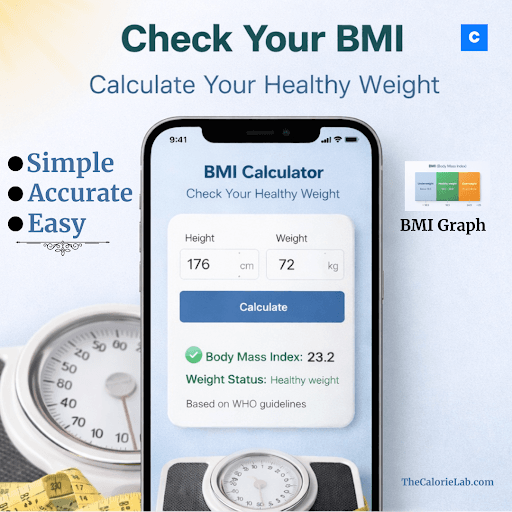
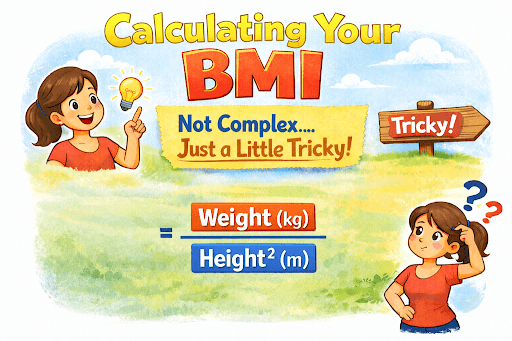
BMI uses a simple formula to divide your weight by your height in meters squared. Let’s suppose you have 70 kg with a height of 1.7 m, so your BMI will be 24.2, which is healthy. Now let’s understand the normal adult’s BMI weight categories.
Understanding BMI Categories and Their Meaning
You should not rush toward BMI results until you know the BMI weight categories and how these categories vary person to person. First, let’s discuss normal adult BMI weight categories, and then we will discuss their limitations.
BMI Categories
Find out which category your BMI falls into using the chart below:
| BMI Range | Category |
|---|---|
| Under 18.5 | Underweight |
| 18.5 – 24.9 | Normal weight |
| 25.0 – 29.9 | Overweight |
| 30.0 and above | Obesity |
NOW let’s discuss a little description of different weight categories
BMI Categories with Descriptions
Below are the BMI categories along with brief descriptions of what each category means:
Underweight (BMI < 18.5)
Being underweight may indicate malnutrition or other health concerns, and could affect your body’s ability to function properly. It is important to maintain a healthy weight through a balanced diet and regular physical activity. If you’re underweight, it may be beneficial to consult with a healthcare provider to assess your individual health needs.
Normal weight (BMI 18.5 – 24.9)
This category represents a healthy weight. People in this range typically have a lower risk of developing chronic diseases such as heart disease, diabetes, and high blood pressure. To maintain this healthy weight, it’s important to continue eating a balanced diet and engage in regular physical activity.
Overweight (BMI 25.0 – 29.9)
Being overweight can increase the risk of developing health problems such as heart disease, stroke, and type 2 diabetes. Individuals in this category are encouraged to adopt healthier eating habits and increase their physical activity levels to reach and maintain a healthier weight.
Obesity (BMI 30.0 and above)
Obesity is linked to serious health conditions such as heart disease, high blood pressure, type 2 diabetes, and certain cancers. It is highly recommended to seek guidance from a healthcare provider for a tailored weight loss plan that includes diet changes, exercise, and potentially medical interventions.

Why Is BMI Important for Your Health?
If BMI is not perfect, then why is it recommended?
The BMI itself is not a perfect tool, but it is linked with other tools and plays an important role in your health screening. BMI is the starting point of a health checkup, and it is linked with other tools to produce high-value data regarding your health.
Most people use a BMI calculator to avoid manual errors. It is working in all BMI calculations, like women, men, children, and older people as well. You can simply consider it as all in one.
It is already linked to other necessary tools for your health, so you can easily see your health status all in one place.
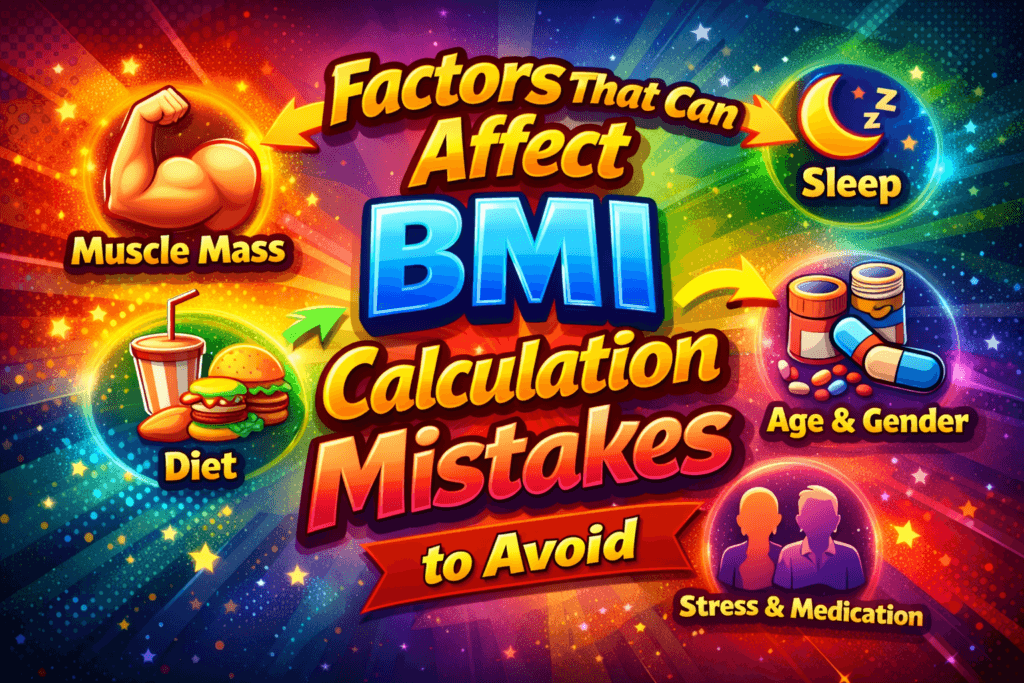
Factors That Can Affect Your BMI Calculation
Biological and health factors.
Muscle Mass
This factor usually applies to athletes. They have a high BMI score, but they are physically very fit. It is because the BMI tool cannot measure the difference between body fat and muscle mass.
AGE
BMI index scores can vary with age group. Its score can be different for adults, children, and older age persons because they get changes in muscle mass over time
Gender
Yes, gender is also a factor in different BMI scores; it is because of different body composition and muscle mass.
Ethnicity
Ethnicity (a group of people) is also a factor; it refers to the group of persons living together, like Asians, Americans, etc. Their genetic changes are according to the environment, which also plays a role in different BMI scores.
Pregency
As we know, pregnant ladies get overweight, which BMI shows as overweight, but originally it is because of the baby in their womb.
But the good news is that we have made a final and tested BMI calculator that gives you more precise results while keeping in view the above-discussed factors.
Here, you can also learn how to calculate BMI for Children, Adults, and Ethnic Groups differently.
Health and lifestyle factors that can affect BMI score.
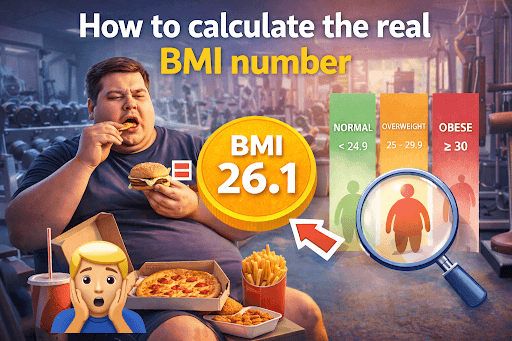
Diet and physical activity
You need to give proper focus to your diet if you do not eat a nutritious diet, so you can face the underweight category, which results in fatigue and other health issues. And the same if you eat too much, so you will start to move towards the overweight category.
But here, physical activity can be very helpful, which will help you out to control and burn extra calories.
Sleep
I know you are wondering how lack of sleep can cause high BMI. Let’s find out. If you do not get enough sleep, you will feel low energy, and to tackle this, your body releases the hormones that produce the craving for high sugar and calorie-dense food.
This food is rich in sugar and calories and low in fiber. As a result, your weight graph starts to move upwards.
Stress and Medication
In a stress state, you face different reasons that can increase your BMI. For example, lack of sleep because you are stressed, which leads to the craving for fast food, as we discussed above.
Medications are also a factor. Actually, some medicines can cause weight gain, which can lead to a high BMI score.
Common BMI Calculation Mistakes to Avoid
Below are some common mistakes that lead to calculation errors
Inconsistent units
It’s usually a human error that we mix the input information. We put our height in the weight box and the same weight box in the height box. It doesn’t seem to be a big problem, but you need to be careful.
Incorrect Height Measurement
While you measure your height, make sure not to put on shoes and stand straight against the wall with heels together. It is important to measure the correct height if you want accurate results.
Manual Calculations
Sometimes you just try to measure the BMI by yourself, so you often forget to use the accurate formula, so you need to use the BMI calculator tool so you do not face this problem.

When Should You Consult a Healthcare Professional About BMI?
You have to consider a health care consultant if you are trying to improve your BMI but still not improving, or maybe you are experiencing a rapid increase or decrease in your health. Moreover, if you are very overweight or underweight, it is recommended to consult a health specialist.
What is Body Mass Index (BMI)?
BMI stands for body mass index. It is a basic health screening tool used by many experts and plays a beneficial role in your health checkup. If you are interested in knowing more about BMI, you can check the BMI Basic Guide.
BMI vs. Other Health Indicators: What You Need to Know
As we know, BMI is itself a basic health tool, and it has some limitations. Now, let’s discuss some other health tool indicators that are useful for specific purposes
1. Waist Circumference (WC)
This tool is useful to measure the exact level of fat in your body
2. Metabolic Health Markers
This tool indicates inner metabolism problems, such as blood pressure and cholesterol levels in our body
Why is BMI a better choice
Now you will wonder if other indicators are available, why we still use BMI as the primary health indicator. The answer is simple because the BMI tool is easily available, and it is free.
Other tools may require subscriptions, but it is a free tool; moreover, it covers overall results.
A health expert combines the BMI tool with other health tools to purify the results. You can consider BMI as a thermometer and other tools as further health tests.

How Accurate is BMI as a Health Measure?
BMI is useful because it can quickly tell you your weight category and give you a general idea about your health. Moreover, it is also useful to measure the data for a large population group.
BMI is not very accurate; it has some limitations, such as
1. Muscle vs Fat
2. Fat Distribution
3. Age, Gender & Ethnicity (a group of people)
If you are confused about how to measure BMI correctly, you don’t need to worry at all. You can check our specific content, in which we discuss how to measure BMI correctly.
Conclusion
BMI itself is a basic health screening tool, but still useful. You can consider the BMI tool to work the same way as a thermometer. You cannot deny its importance.
Doctors and health experts combine BMI with other health indicators to know about the current health status of individuals. It is also used to check health status at a population-level measurement of a large group.
You can also get here the latest updates on BMI.
FAQs
1. What is BMI, and how to calculate BMI?
BMI is a basic health screening tool. For more BMI guidance, visit our BMI Basic Guide content. Great news! Now you can automatically calculate your BMI with any BMI Calculator that works according to the WORLD HEALTH ORGANIZATION (WHO).
2. Why does BMI ask for ethnicity?
BMI can be different because different groups of people may have slight differences that are the result of the evolution of humans according to their environment.
3. Why is my BMI so high, but I am not fat?
There can be multiple reasons behind this concept; reading our content on what your BMI number actually means is recommended.
4. What is the main purpose of using BMI?
The BMI provides an overall basic health checkup of your body at no cost, so that’s why people often use the BMI tool.
5. Does BMI change with age?
You will get different muscle mass across different age groups, so age can also be a factor.
6. What is the BMI formula?
The BMI formula is simple and easy; you can divide your weight by the square of your height.
7. What is a healthy BMI range?
A healthy BMI of a common adult is usually between 18.5 and 24.9.
8. Is BMI accurate for everyone?
BMI may not be accurate for everyone. It can have different results for individuals like athletes and women.
9. How do you calculate BMI for a woman?
Women have different body compositions. They have different muscle mass, but don’t need to worry; here you can use our BMI Index Calculation system to get accurate results.
10. Is BMI the only way to measure health?
No. BMI is a basic health tool that can give you just a round about idea of your health. There are many other tools that you can use. Other tools, like waist circumference, are used to measure the exact body fat percentage.
11. What are healthy BMI ranges for adults?
Normally, a BMI score between 18.5 to 24.99 is considered a healthy weight category, but this BMI can have some limitations. To understand the limitations of BMI reading, our content is recommended.
12. What are some examples of BMI calculations for different heights and weights?
1. A person weighing 70 kg with a height of 170 cm (5.7 feet) has a BMI of 24.22, which falls in the healthy weight category.
2. A person weighing 40 kg with a height of 150 cm has a BMI of 17.88, which is considered underweight.
3. A person weighing 80 kg is not automatically overweight. BMI depends on height, so weight alone cannot determine the BMI category.
13. What is the healthy weight for a 5’7″ woman?
A weight between 55-67 kg is considered a healthy weight for a woman.