BMI and Health Risks: Understanding Your Body Mass Index
Let’s suppose you calculate your body mass index (BMI), you will see a number on the screen. This number tells you whether you are underweight or overweight, and it might tell you that you have a healthy weight.
But what if it tells you your BMI is too high or too low?
Should you panic?
Or should you ignore it?
Or should you actually take it seriously?
Nowadays, many people calculate their BMI and instantly get worried about it. Some people may get relieved. But the truth is that BMI helps to identify body weight-related risks; it does not measure body fat, muscle mass, or overall fitness. It should be used as a screening tool, not a final health diagnosis.
3 Major BMI Health Risks You Should Know
Your BMI is not just a random number. It can act as a warning sign for you by highlighting risks for your health, but it is not a final result.
Here are the 3 main BMI risks to the body:
1. High BMI and Risk of Chronic Disease
If your BMI is high, it usually tells you that you have extra fat. Too much body fat puts long-term pressure on your organs.
This increases the risk of:
1. Heart disease
2. Type 2 diabetes
3. High blood pressure
4. Stroke
Think of it like this:
A car that carries too much weight all the time, and then at last, its engine wears out faster than the normal routine.
Similarly, your extra fat makes your organs have to work harder than normal, which produces weight-related risks.
2. Low BMI and Weak Body Functions
People think that only being overweight causes disease, but in reality, an underweight body may also cause health problems.
If you are underweight, you are not getting enough nutrients, which leads to diseases like:
1. Weak immunity
2. Feel tired all the time
3. Weak bones
4. Hormone imbalance
Like a car, your full body needs enough fuel to work properly and to become strong. So yes, low BMI can also be a warning for your health.
3. Long-term Health Stress on the Body
Whether your BMI is too high or too low, you may face stress in the body over time.
For example:
1. Extra weight in the body can cause joint pain.
2. Similarly, low weight in the body can reduce your muscle strength.
3. Lastly, both can affect energy levels.
And over time, small problems can grow into bigger problems. And that’s why BMI should not be ignored.
BMI does not consider fitness level, age, or gender, which highlights the limitations of the BMI.
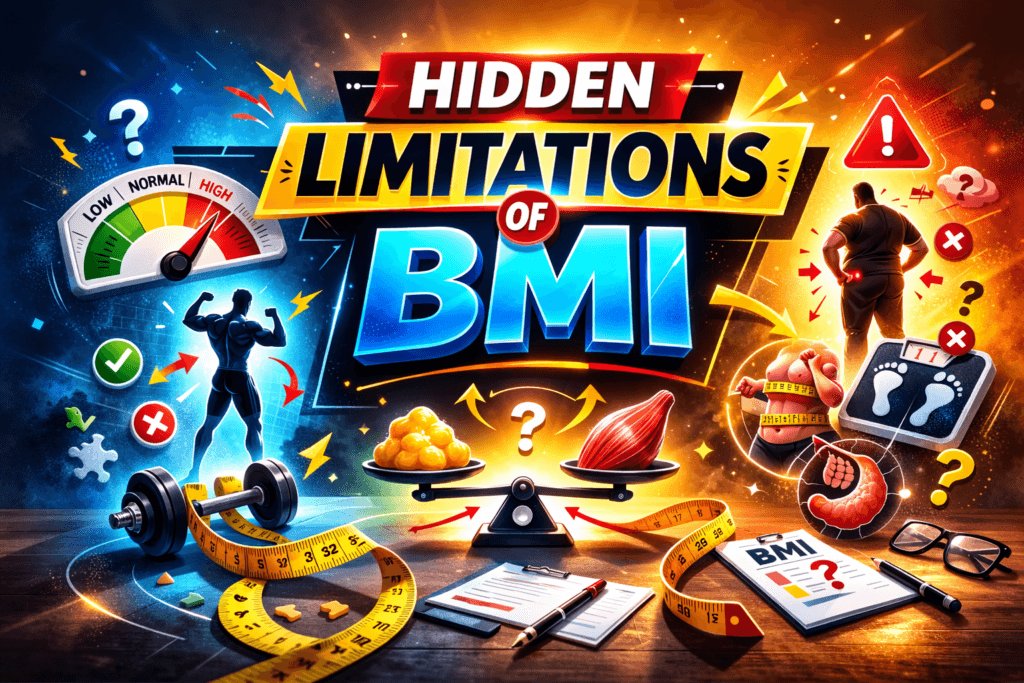
Hidden Limitations of BMI
As you know, your body is very complex, but BMI only uses your weight and height to check your health status with the use of this basic formula:
BMI = Weight (kg) ÷ Height (m²)
So now let’s understand what your BMI number does not tell you about your health.
1. BMI cannot tell the Difference Between Muscle and Fat
This is one of the biggest limitations of BMI because your muscle weighs more than your fat.
Understand it by imagining these two people:
1. Person A has more fat in his body.
2. Person B is a gym athlete, and he has stronger muscles in his body.
Both of them have the same high BMI value, but their bodies are built differently. Here, person B has a healthy body, but BMI gives their weight as overweight.
That is why, most of the time, BMI says a healthy person is overweight, which is not true. This happens usually because BMI only looks at the weight and height of the body and does not look at muscle and fat. So you need to get complete guidance about BMI before checking it.
2. BMI does not show where Extra Fat is stored
You need to know for yourself where your extra fat is stored in the body, as BMI is not capable of telling you that, which is also a major limitation of BMI.
It only calculates total body weight in relation to height.
3. BMI does not consider Age & Gender Properly
As we age, our body structure changes. Like:
1. Older adults lose muscle over time.
2. Women have more body fat than men naturally.
BMI does not adjust for these differences that may cause risks in the body.
4. BMI ignores Lifestyle and Fitness level
When you are calculating your BMI, it doesn’t tell you whether you exercise or not, or whether you eat a balanced meal, or whether your blood pressure is normal or not.
It is just because BMI is a basic health indicator tool. It is not a full report of your health. It does not consider your fitness level and your lifestyle factors that also impact your full body’s health status.
It is just like a smoke alarm; when it alarms, you will check it further. But the alarm itself is not a fire.
Is BMI an Accurate Measure of Health?
Yes, but not completely. It is accurate in calculating your weight according to your height.
But it does not measure:
1. Body fat percentage
2. Muscle mass in the body
3. Blood sugar
4. Body fitness level
So, BMI is useful, but it is used in limited aspects of the body, not for the whole body’s health.
When BMI is useful
BMI works well mostly as a first check of body status. Doctors and healthcare experts use BMI in their normal routine for these things:
1. Check possible weight risks for the body.
2. Decide if further testing is needed for the body.
3. Quickly screen the overall condition of the body.
This is because it is fast, simple, and free to use to check a person’s health through a BMI calculator that works on a world health standard.
When BMI is not Enough
BMI is not accurate for:
1. Athletes with high muscle
2. Very muscular individuals
3. Pregnant women
In these cases, BMI will give a confusing value. And you will also learn here how to calculate BMI manually, which helps you to calculate additional measurements like body fat percentage provide better insights.
A Smart way to use BMI
After calculating your BMI, do not ignore the result because it may cause health risks for your overall health over time.
And the smart way to use BMI is to use it in your daily routine to check your basic health status and take a general guide for your health. Avoid using BMI for the final results. It is only a basic guide.
Conclusion
Your BMI is a calculated number for your body. BMI can help you to notice possible health risks. It can give you a warning sign for your health, but not give a complete diagnosis.
It does not measure your muscles or your fat. So, that’s why, use BMI wisely in your life.
If your BMI gets too high or too low, do not worry. Take a balanced diet and exercise regularly.
FAQS
1. What are the main BMI Health Risks?
The main BMI risks for health depend on your weight category:
1. A high BMI may increase the risk of heart disease and high blood pressure.
2. A low BMI may lead to weak immunity and low energy.
This only indicates risks, not a complete solution.
2. Is BMI an accurate measure of your health?
Yes, it is a useful health screening tool, but it is not a complete solution for your health. As it only uses weight and height and does not measure body fat or muscle mass, etc. It just gives you a basic status of your health.
3. Why does BMI have some limitations?
The Body Mass Index has some problems. It cannot tell the difference between fat and muscle, and it also does not show where the fat is in your whole body. This is why some people with a lot of muscle may have a high BMI, but they look really healthy.
4. Should you worry if your BMI is high with respect to your height?
You should not panic; instead, you should pay attention to yourself. A high BMI may cause risks to the body. So, take a balanced diet and exercise regularly.
5. What should I check along with BMI?
To understand your health better, you can also check these things along with BMI:
1. Waist circumference
2. Fat percentage in the body
3. Blood pressure
4. Physical activity level
5. Cholesterol
These will give you a clearer image than BMI alone, and you will get a healthy weight.
6. Can someone with a normal Body Mass Index still be unhealthy?
Yes, it is possible because they may have unbalanced eating habits, low activity levels, or unhealthy blood test results that make them unhealthy even in their healthy weight.
7. Can a low BMI person not have any health problems?
No, a person with a low Body Mass Index may have some health problems, like weak bones and a weak immune system. And, this person may feel tired all the time.
8. What is BMI, and how to calculate BMI correctly?
BMI is a health screening tool. For more BMI guidance, visit our Basic BMI Guide content. And, now you can automatically calculate your BMI with any BMI Calculator that is based on guidelines from the WORLD HEALTH ORGANIZATION(WHO).
9. Can we calculate BMI for children, adults, and ethnic groups differently?
Yes, you can calculate BMI for 3 different groups by understanding how to calculate BMI for 3 different groups, in which you will learn the major rules to calculate accurate BMI for children, adults, and ethnic groups differently.
10. What are the main categories of BMI?
There are 4 main categories of BMI that give you a quick signal on your health and alert you to any health issues.
1. Underweight (Less than 18.5)
2. Normal (Between 18.5 – 24.9)
3. Overweight (Between 25 – 29.9)
4. Obese (Greater than 30)
You should make a habit of checking your Body Mass Index regularly for a healthy life.