What is BMI and Why Does It Matter for Different Groups?
Many people wonder why two people with the same BMI may have different health conditions. This happens because BMI does not work the same for adults, children, and ethnic groups.
However, the basic BMI formula remains the same for everyone. So, how do we calculate BMI differently for all groups?
Let’s understand this by the basic formula for BMI, that is;
BMI = Weight (kg)÷Height (m²)
Now, why does BMI work differently for adults, children, and ethnic groups? This happens because each group has a different body structure that may give the same BMI, but it does not reflect the same health status.
How BMI Is Calculated for Different Groups
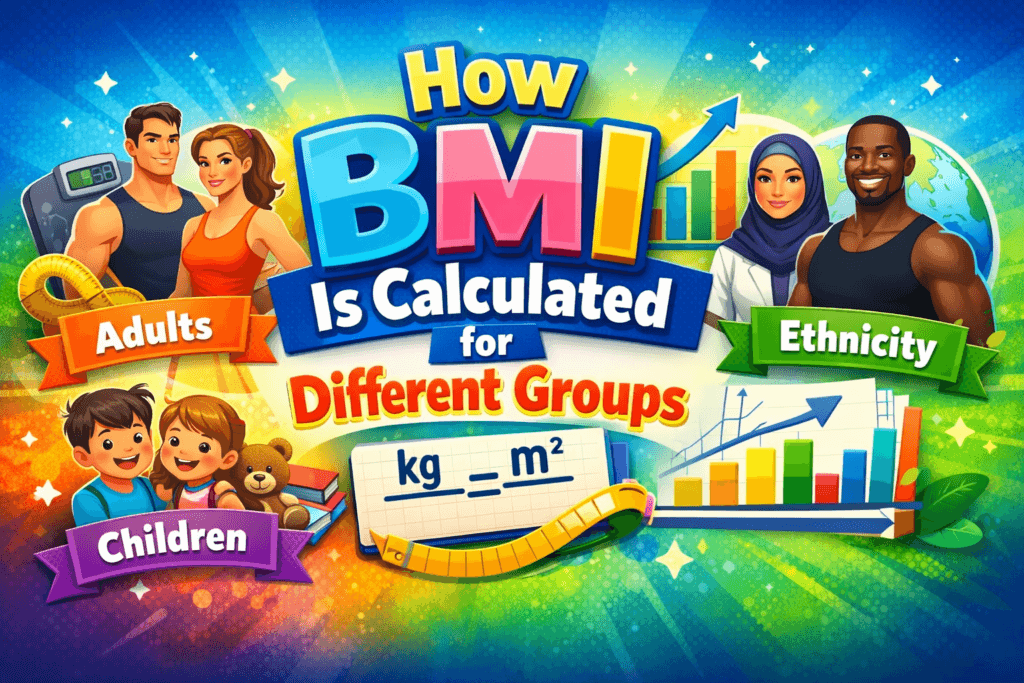
Basic BMI is calculated using the standard formula according to the WORLD HEALTH ORGANIZATION (WHO). But for different groups, we will focus on the body structures of adults, children, and ethnic groups differently.
You can also calculate BMI manually to understand your results better.
How to Calculate BMI for Adults: A Comprehensive Guide
You can calculate adult BMI using a simple formula that is based on their body weight and height. Most doctors and healthcare experts use this method in their normal routine, that is;
BMI = Weight (kg) ÷ Height (m²)
And when you calculate your BMI, the doctor suggests you combine your BMI with body mass categories. This will help you to understand whether you are healthy or not.
BMI for Children and Teenagers: What you really need to know
BMI for children and teenagers is different from that of adults because they are still growing. You will calculate their BMI normally, but you need to compare it with their age and gender.
Doctors use different percentiles for children, which are referred to as the BMI-for-age percentile.
Now, here you see the BMI percentile categories for children:
👶 BMI Percentile Categories for Children
For children and teenagers, BMI results are interpreted using age- and gender-based percentiles instead of fixed numbers.
Underweight
Below the 5th percentile
Healthy Weight
5th – 85th percentile
Overweight
85th – 95th percentile
Obese
Above the 95th percentile
BMI in Different Areas: How Ethnicity Affects BMI
Clearly, BMI is an effective health indicator tool all over the world, but what if it does not work the same in every area?
Studies show that most of the population in Asian areas may have higher fat in their bodies than the European population. So, their BMI also works differently on them.
Moreover, Africans also have a higher density in their muscles, which usually makes their BMI higher, but they still seem healthy and physically strong.
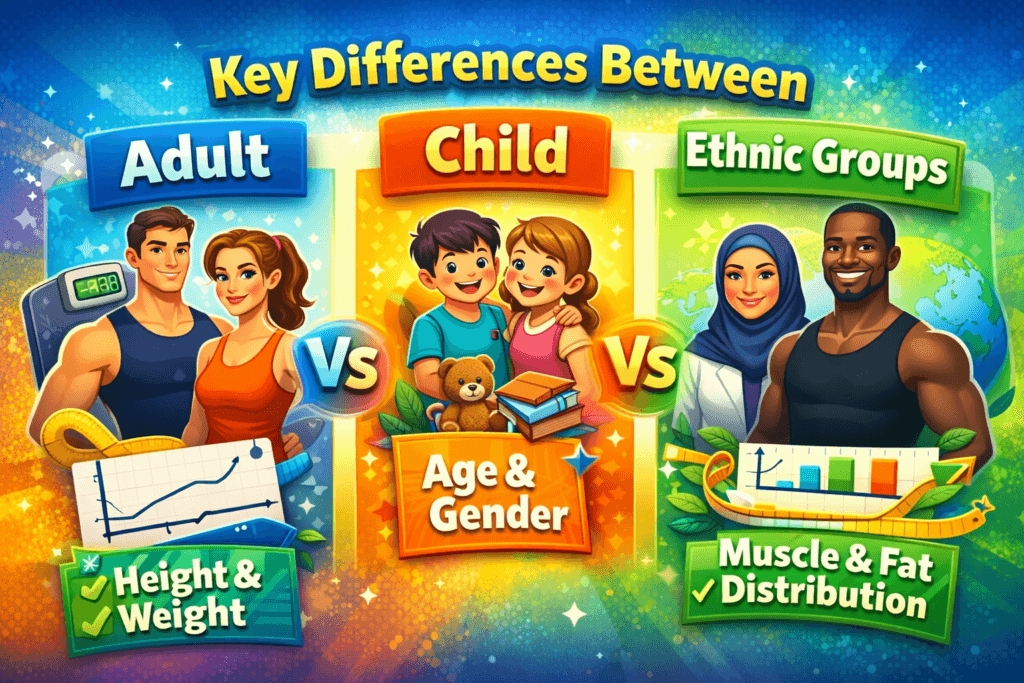
Key Differences Between Adult, Child, and Ethnic Groups
Now, this shows that the BMI is not the same for everyone.
Adult BMI is based on height and weight.
Children’s BMI depends on their age and gender.
Ethnicity, which depends on muscle mass, is different across all populations.
That’s why the same BMI value may be healthful for one group, but it may be unhealthy for another group, because everyone has a different body structure.
Here, you get major differences among them to understand more easily.
BMI Comparison: Adults vs Children vs Ethnicity
Adults BMI
BMI for adults uses a fixed formula based on height and weight. The result is classified into standard categories such as underweight, normal, overweight, and obese.
Children & Teenagers BMI
BMI for children and teens is calculated using the same formula, but interpretation depends on age and gender percentiles Due to continuous physical growth.
Ethnicity-Based BMI
Ethnic BMI standards vary because body fat distribution differs across populations. Some ethnic groups face health risks at lower BMI values.
The same BMI number can indicate different health meanings Depending on age, growth stage, and ethnicity.
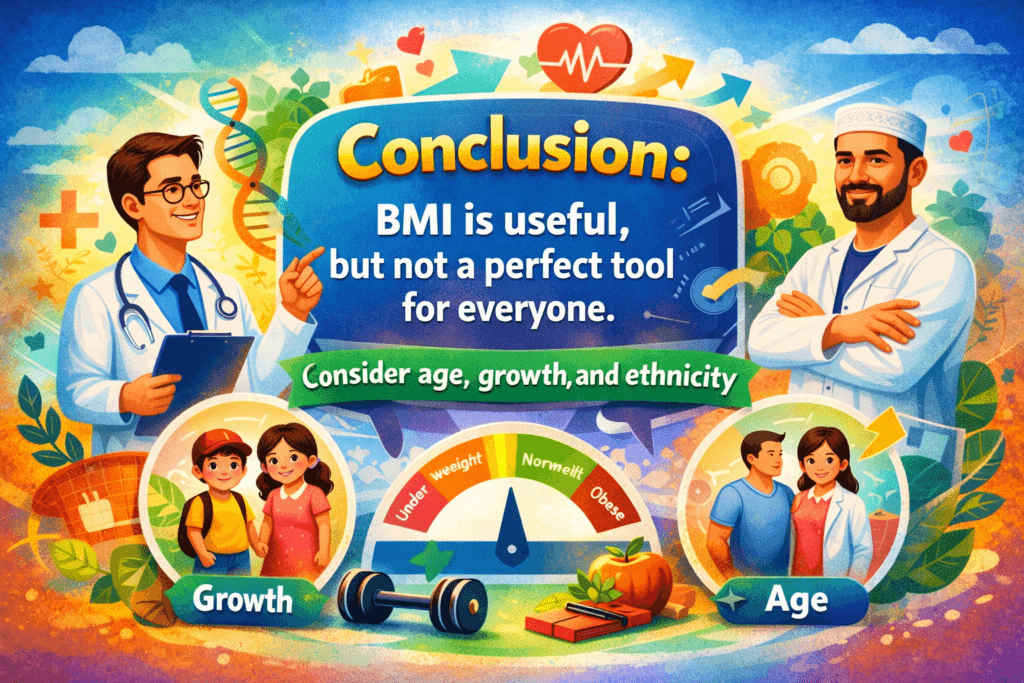
Conclusion
Today, BMI is a useful tool for basic health, but healthcare experts do not suggest this as the perfect tool for everyone because everyone has a different body structure. You can learn here the basic rules to calculate BMI for health.
For Adults, we can use just a normal formula. And For Children, we vary BMI with age and gender. And lastly, For Ethnicity, we will combine body fat for better decisions.
Here you can learn the limitations of BMI and health risks for body.
FAQS
1. Why is BMI different for adults and children?
As adults complete their full growth, children are still in the growing stage. So their BMI is different. Adults use just a basic formula, but children compare their age and gender.
2. Can two adults who have the same BMI have the same health status?
Yes, two adults with the same BMI may appear to have similar health status. Because their body structures are the same according to their lifestyle factors.
3. Why do healthcare experts use BMI percentile for children?
Healthcare experts use the BMI percentile for children to check a child’s growth by comparing with other children of the same age and gender to check the child’s health condition more accurately.
4. Does BMI work the same in all ethnic groups?
No, Different ethnic groups have different masses in their body and have different body structures. You may calculate BMI manually on your own to get a better health status for them.
5. Why do Asians have a health risk at a low BMI?
Most of the Asian population may have low BMI, but they have high body fat. And because of this, they may have health risks in lower BMI.
6. Is simple BMI enough to understand my health status?
No, BMI gives you just a basic guide about your health status, but it is not recommended to use just BMI for your health. Your lifestyle, your diet, and your physical activities are also a part of your body and affect your health condition.
7. At what age do adults start using BMI?
Normally, adults apply their BMI after the age of 18. Before this, they are in their growing stage. And they get their maximum height. After this, they calculate BMI more accurately according to their body weight.
8. Is it possible that your body mass is not increasing, but still your BMI increased?
Yes, it is possible. If your muscle mass is starting to increase, and in the end, your health condition may improve even if your weight remains the same. Your BMI is starting to move towards a healthy weight.
9. What is the best way to use BMI?
First, remember, use BMI for just basic guidance, not for your final decision. And after calculating BMI correctly, combine your BMI with your daily lifestyle habits and your daily diet to get your accurate health status.
10. What is the basic formula for BMI, and how do we calculate our BMI manually?
It is good for you if you calculate your BMI manually on your own, because it gives you an accurate result.
And the basic formula for calculating BMI is simple that is:
Your BMI = Your Weight (kg) ÷ Your Height (m²)