BMI Formula and Its Definition
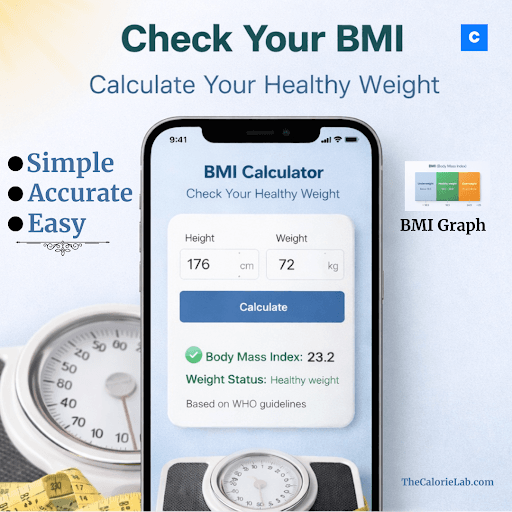
BMI is a simple method that is used to check your health conditions based on your height and weight, according to the basic formula that is:
BMI = Weight (kg)÷Height (m²)
Now, you will learn here about BMI’s newest updates that help you to check what your BMI number actually tells about your health.
Understanding BMI: Formulas and New Updates
For many years, the BMI standard formula is just dividing your weight by height squared according to the WORLD HEALTH ORGANIZATION (WHO) system.
But now, you should also learn the latest updates on BMI calculations. Well, according to recent studies, it seems that the BMI does not consider muscle mass, age, and gender in its calculations. So you should take updated precautions accordingly.
What is the BMI Classification? A complete Explanation
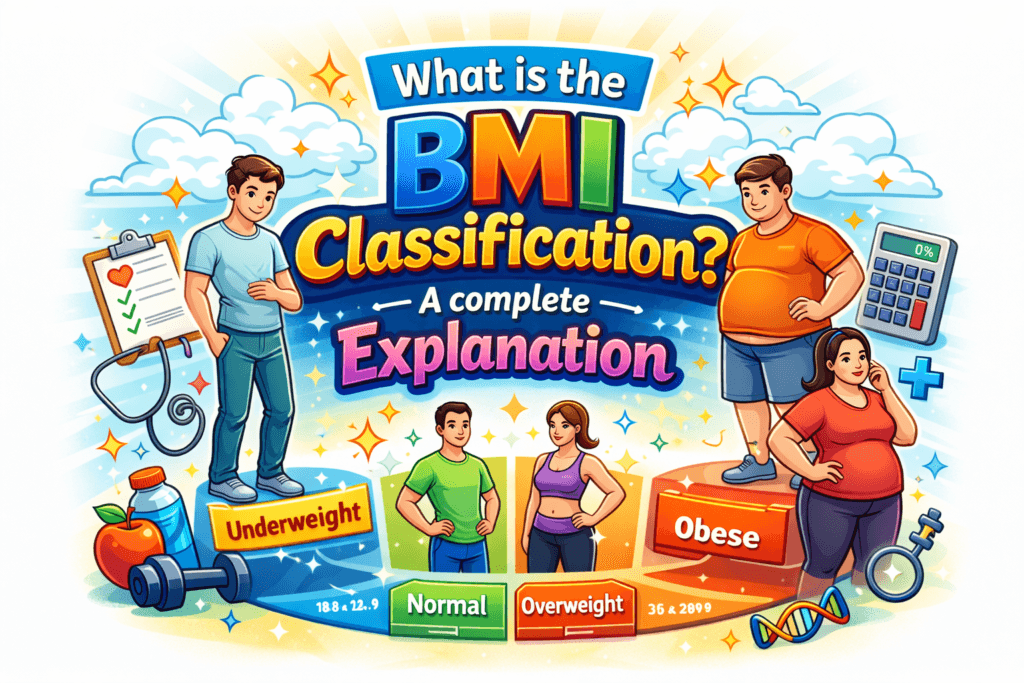
In simple language, BMI classification is that the BMI actually tells you the category in which you are falling right now: Whether you are underweight, overweight, healthy, or obese (the next stage of overweight).
📌 BMI Classification Table
This table helps you to understand what your BMI number really tells and in which weight category you fall.
| BMI Range | Weight Category | What It Means |
|---|---|---|
| Below 18.5 | Underweight | Your weight is lower than a normal person’s weight for your height. |
| 18.5 – 24.9 | Normal Weight | Your weight falls in a normal range, and you look healthy. |
| 25.0 – 29.9 | Overweight | Your weight is slightly higher than the normal range. |
| 30.0 and above | Obese | Your weight is higher than normal weight, and it has high health risks. |
But remember, your BMI category gives you a general basic idea of your health status, but it does not tell you the full story of your health condition.
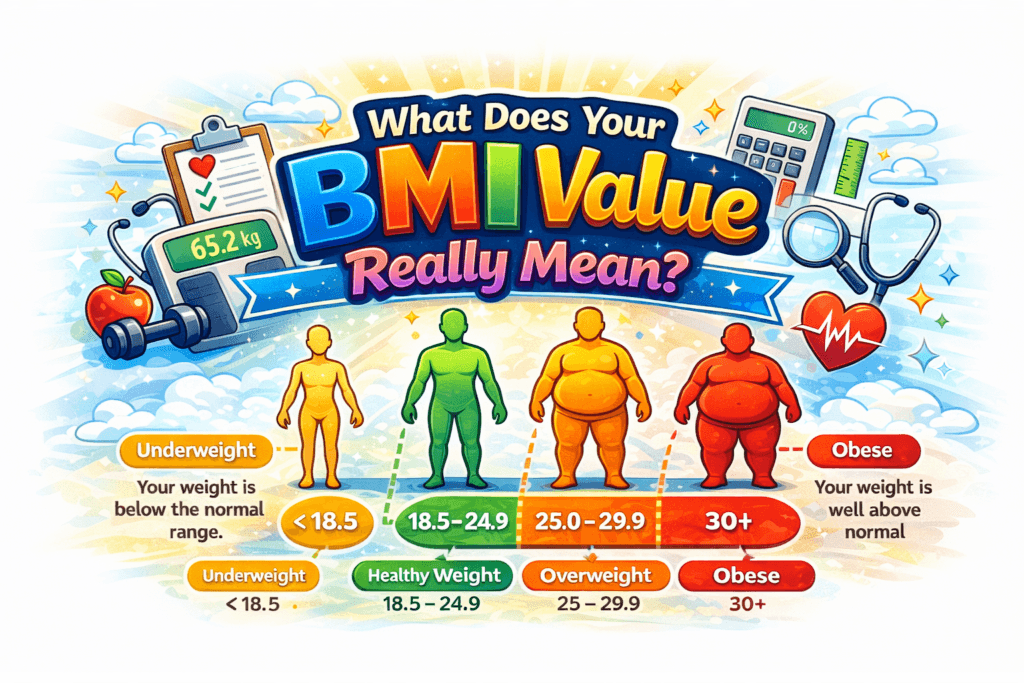
What Does Your BMI Value Really Mean?
Now, one important thing that everyone has to understand is that the BMI value is just an indicator of your health. It helps you to make good decisions for your health improvement.
Now let’s talk about the different results that BMI gave you about your health, in which you have:
1. Underweight
2. Overweight
3. Normal Weight
4. Obese
1. Underweight: People who have a low weight and look slim and smart are considered in the category of underweight. Their BMI is below 18.5.
They should take more calories daily to gain a healthy weight in their body.
2. Overweight: Some people have a higher weight than normal, and they look slightly overweight. They fall in the overweight category. Their BMI is greater than 24.9 and less than 30.
They should burn more calories on a daily basis and consume normal calories to gain a healthy weight.
3. Normal Weight: People who look healthy and have a normal weight fall in the healthy weight category. To achieve this category, you have to maintain a BMI between 18.5 and 24.9.
You should follow a proper diet and do daily exercise to maintain a healthy weight.
4. Obese: Some people are of high weight, and they have a high health risk. They seem fatter than an overweight person and have a BMI greater than 30.
These people need to check their current BMI and hire a healthcare expert to check their health condition and take proper precautions accordingly.
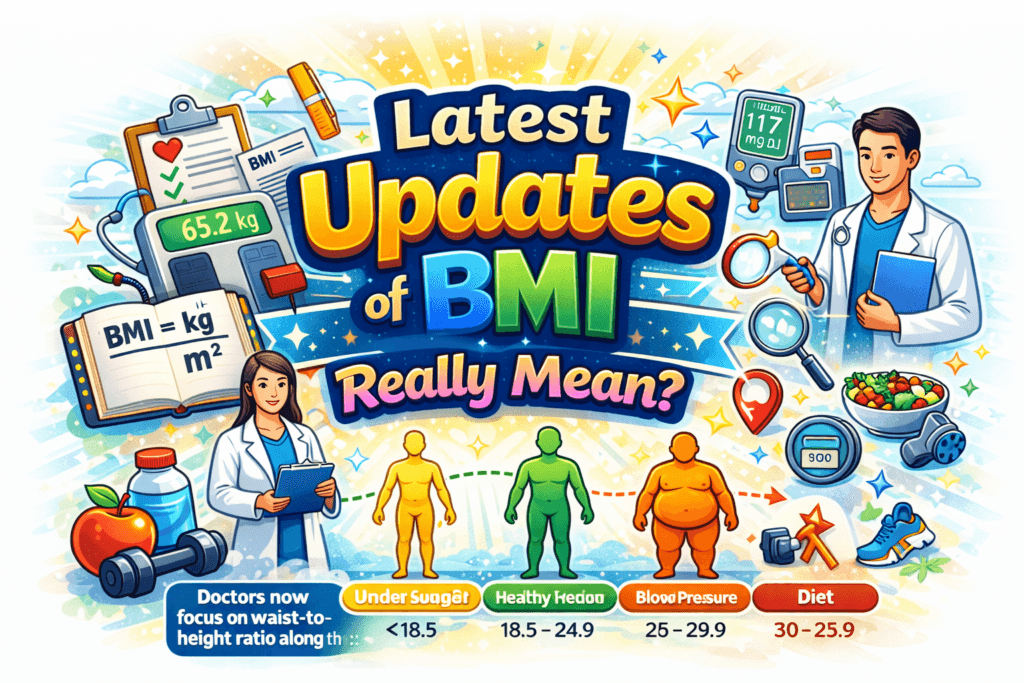
Latest Updates of BMI
While using and understanding BMI, it is better for you to check daily updates on BMI according to the WHO standard, and check your BMI regularly.
Here are some updates on BMI
1. Doctors and healthcare experts are making BMI an initial step for any health measurements for any person.
2. Basically, BMI tells the basic relation between the mass and height of your body.
3. Now, according to the latest studies, healthcare experts are also focusing on another metric, that is the ratio of waist to height, which is now very useful to indicate any heart disease.
Waist circumference ÷ Height (Waist-to-height Ratio)
4. One of the latest news is that in Asian people, underweight persons also have health risks.
5. Now, BMI is not calculated alone; in fact, it is now calculated with combinations of diet quality, blood sugar, blood pressure, and physical activity.
Now, you can also learn here how to calculate BMI for Children, Adults, and Ethnic Groups diifferenly.

Conclusion
While BMI remains a useful basic indicator for your health, but the latest health guidelines are also combining it with human body composition and waist-to-height calculations, as well. It also impacts lifestyle factors. And daily blogs also help you to understand daily updates and to use health tools as well.
You can also calculate your BMI easily on an online tool website.
FAQS
1. What is BMI in simple wording?
A BMI is just a number that tells you whether your weight is healthy with respect to your height.
2. What is the correct BMI formula?
The BMI basic correct formula is given below that is
BMI = Weight (kg) ÷ Height (m²)
This formula is used all over the world for every person.
3. What are the names of all categories of BMI value?
There are 4 basic BMI categories:
1. Underweight
2. Overweight
3. Normal weight
4. Obese
These are the categories that tells basic health condition of your health.
4. Which BMI range is considered a healthy range?
The BMI of 18.5 – 24.9 is considered a healthy range for a healthy person.
5. Is BMI considered as 100% accurate?
No, BMI is not considered as 100% accurate due to some reasons, such as it does not consider:
1. Muscle Mass
2. Age
3. Gender
That’s why it just gives a basic health indicator of your health.
6. Can underweight people have health risks?
Yes, recent studies tell that underweight people may also face health risks, especially in Asian countries.
7. How often do you have to check your BMI?
You should check your BMI monthly or if you notice any changes in your body, because it gives basic health indicators about your health.
8. Does BMI change with your age?
Yes, as your age increases, your body fat distribution system changes. But still, your BMI formula will be the same, but your BMI varies with your age.
9. What is the waist-to-height ratio?
Now, healthcare experts are focusing on another metric, that is, the waist circumference, and are now calculating the waist-to-height ratio, which is also used as a basic health indicator.
10. Which BMI is considered a health risk for the human body?
The BMI that’s below 18.5 and the BMI that’s above 30 is considered a health risk for the human body.
11. Is BMI different for men and women?
Yes, BMI also varies with gender. Men need high weight than women. But the online BMI calculator does not consider it and gives a BMI according to the given information. You can also learn here to calculate BMI manually for better results.